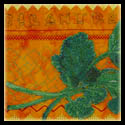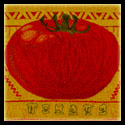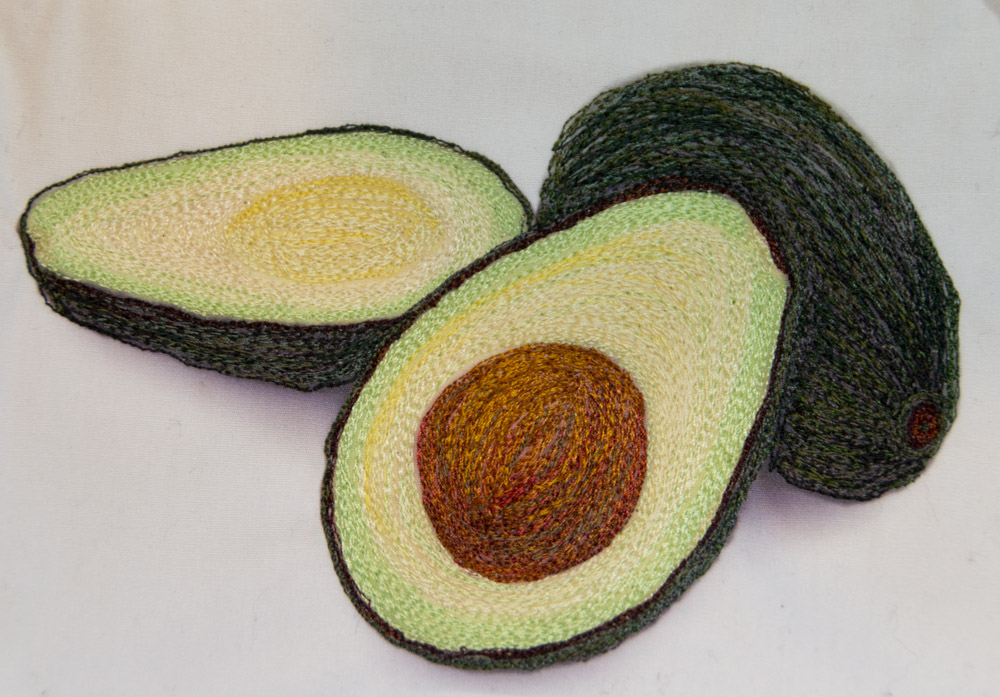
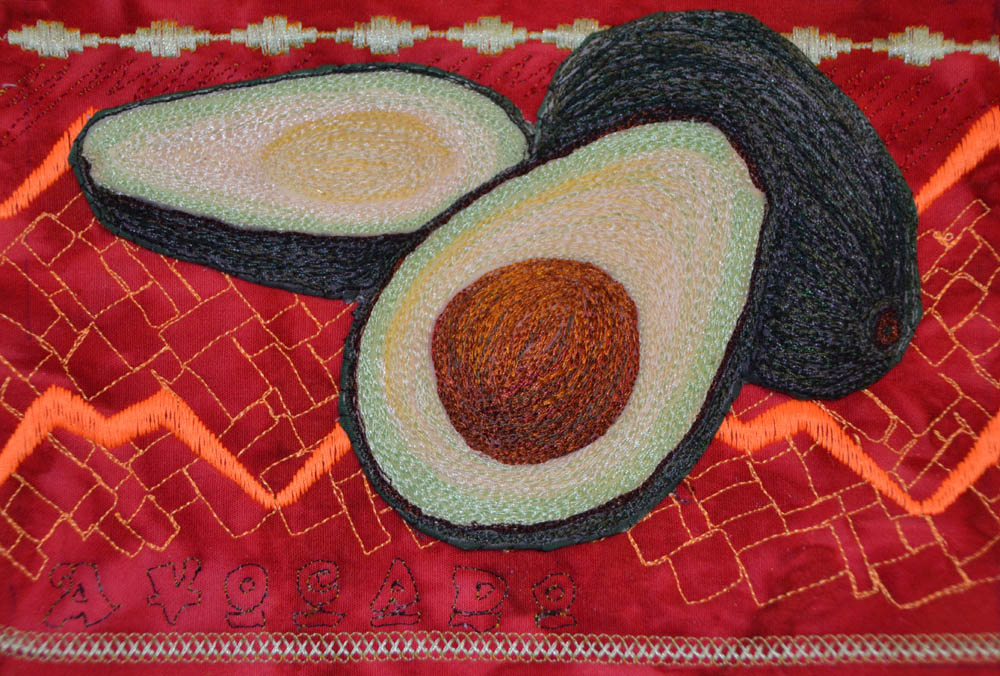
Only 3 more 5 x 7 pieces to go for my Salsa series!  They’re looking good all together.  I was a little worried that this red background might be too dominant with the rest of them, but it turned out fine.  I wanted the complementary color to the green of the avocado, and the dark skin of the fruit allowed me to use something quite bold… there’s no way that the pieces will fade into the background.  I’m still trying to figure out how I’m going to tie all the pieces together- I’m leaning towards black sashing that is freemotion quilted throughout.  I’d love to hear any thoughts or suggestions you might have about putting these pieces together into a quilt.
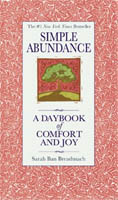
Yesterday I was reading one of my old favorite inspirational books, Simple Abundance: A Daybook of Comfort and Joy by Sarah Ban Breathnach.  Each day of the year has a separate little essay that looks for finding joy in your everyday life.  I’ve had this book and referred to it for probably about 15 years (it was published in 1995.)  It’s a lot like a wonderfully inspirational blog!  Anyway, the entry for March 4 is called “Priming the Pump for Inspiration” and uses the analogy of how you used to have to pour water into a pump to get it started.  Likewise, as artists, we need to feed ourselves images and experiences to keep the flow of creativity.

Similarly, Twyla Tharp, the famous dancer and choreographer, talks about setting rituals to get your creativity flowing.  If you set up a structure of doing the same thing each time you sit down in your studio (or on the way to your studio)… something that is inspirational, or centering, or creates peace for yourself… you will start to get greater access to your creative side.

I can’t say that I’ve got this process of ritual down at all.  I do lots of things to “prime my pump”, whether it be taking photos, cutting out images from magazines and putting them in sketchbooks, or reading books and blogs which I find inspirational.  But, typically I feel a little pressed for time and that I need to produce when I’m in my studio.  I’m rethinking this.  Perhaps I would be better served creatively to take the extra time, slow down a little bit, and follow a set ritual each day to start opening up my right-brain creative side.

You Might Also Be Interested In:

Developing the 
Creative Habit
Peppers and Avocado Cilantro – Si!

Some of my Favorite Blogs:

Leah Day’s FreeMotion Quilting Project

Connie Kresin’s Freemotion by the River

Nina Marie Sayre’s Art Quilts

Freshly Pieced

Quilt Story

Confessions of a Fabric Addict

Quiltsy

Do you feel like you are meeting your potential?  Or do you feel like you haven’t quite made it or like you aren’t really even sure how to get to what you think your potential might be?  
This question is on my mind after celebrating my son’s Eagle Scout Court of Honor yesterday.  I made a slideshow for the program, with pictures of my son’s scouting activities- from first grade through his Sr. year of high school.  It hasn’t always been an easy road… he was even asked to take some time off from scouting at one point.  However, I can now see how all the effort (on both his and my parts) has paid off.  He’s made a great step towards meeting his potential.
“By a Nose” by Christina Fairley Erickson
My quilt won a 1st place at an Equine Art Show… however
it’s done with a technique I learned from Noriko Endo…
does that then truly represent my artistic voice?

One of my quests this year in my 5 x 7 Challenge, beyond the concept of how making art each and every week will help the quality of my work, is to find my authentic voice as an artist.  Finding your voice as an artist seems to be a tricky thing for many of us.  I’ve tried many styles of quilts and am still working out how to have my work represent who I am, and not be something you look at and say… “Oh that looks like ____________(put well-know quilt artist’s name here) work.”  My work should look like Christina Fairley Erickson’s work.

I’m clear that I like pictorial or representational work.  I also like stitch, both machine and hand.  So those are the areas I’m exploring.  But the ways in which I put them together need to be my own.  
I thought I’d share another of the artist’s work from the Bellevue Art Museum’s “High Fiber Diet” exhibit.  Maria Shell, of Anchorage AK, spent a year exploring the potential of variations of pattern over the course of many grid pieces.  Each of the nine pieces is made from vintage and contemporary commercial cotton textiles, hand-dyed fabric, batting and thread. So, your basic quilting components.  
Maria felt that by limiting the structure of her work to the grid, she was able to fully explore color… how to make color vibrate on the wall.  She discovered that the proportion of line and shape in the relation to color evokes different experiences in each piece.  The shot below is looking at a towering 20 foot wall of her quilts.  Each piece is approximately 5 -6 feet square.
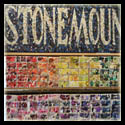
From left to right, starting upper left:  Picnic, Holey Rollers, 36 Ninjas, Speedy Higgins Play the Drums, Solstice, Get On Up, Deep Blue Sea, Funky Monkey, Habanero by Maria Shell
How do we find our authentic voice?  Creative choice is at the heart of authenticity.  So when making our choices, we are exploring our own voice.  However, if your choices are limited or you feel constrained by things you’ve learned from other “experts”, it’s good to also question when to break free of doing things in someone else’s style.  

 How are you living up to your potential this year?  Are you striving to find your authentic voice or do you feel confident in your artistic direction?  I believe that through exploring these themes and types of questions, we become closer to finding our real selves.  Through that, our artistic voice will come through.

You can see the vibrancy in Maria’s work
with this sample from “Deep Blue Sea”
While “Solstice” doesn’t play with color, Maria’s
use of pattern and repetition make for a striking piece
You might also be interested in:

BAM High Fiber Diet Outdoor Fiber Art 
& Call for Entry
Fitting My Challenge
with Showing

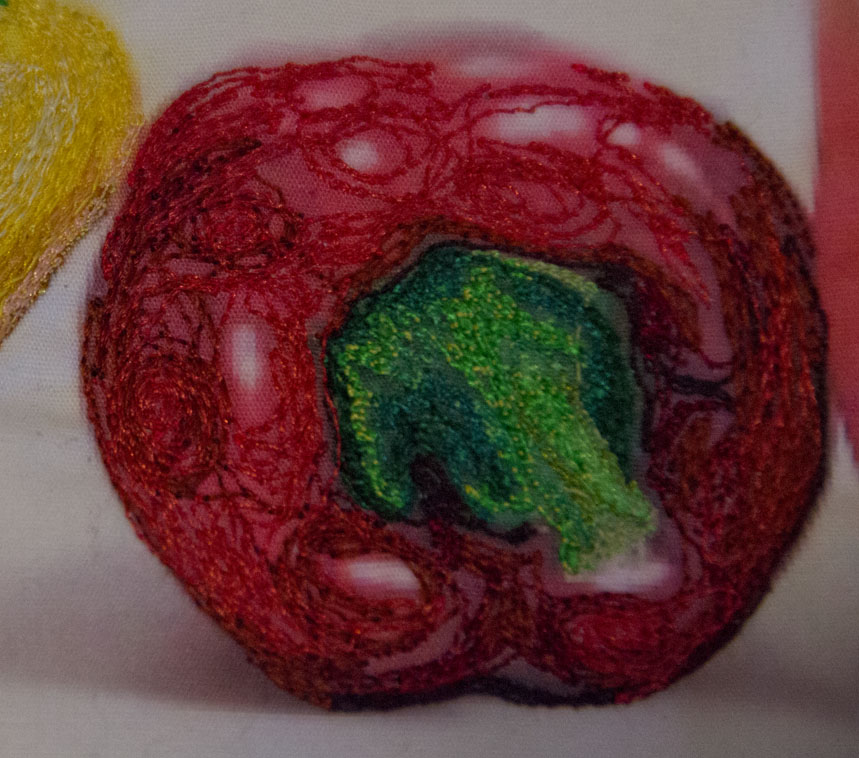
I finished My “Peppers” last night!  Hooray!  I’m quite happy with how they turned out… I struggled with making the red center one laying down so you are looking down on it.  I think the key was both the shading and sewing directional-ly. By this I mean that I’m trying to capture the shape of the object, by sewing in the direction that the object naturally goes.

For instance, where there was a buldge in the pepper, I sewed around any bulbous protusion, which, combined with shading, helps give the illusion of depth. Another way of looking at directional sewing is to think of the way something grows or sewing with the grain of an item. For instance, if you want to portray an animal, it won’t look very realistic if you make the hair going in an unnatural manner.  Similarly, petals, leaves, and plant stems look closer to life with a vertical grain and more cartoonish with horizontal filling.

Background before I hand appliquéd the trapunto peppers 

I also made a decision with the background of this piece.  If you’re familiar with design theory, you’ll recognize “repetition” and “unity” as two fundamental  design concepts. Many strong designs utilize repetition- whether they are visual art, writing or in a musical composition.  Repetition aows the viewer to feel more comfortable with the piece-as if the already know something about it, since they’ve seen (or heard) that part of the piece before. Repetition can also help unify a piece. Having too many loose ends that don’t relate anywhere else in the work can be jarring and disquieting.

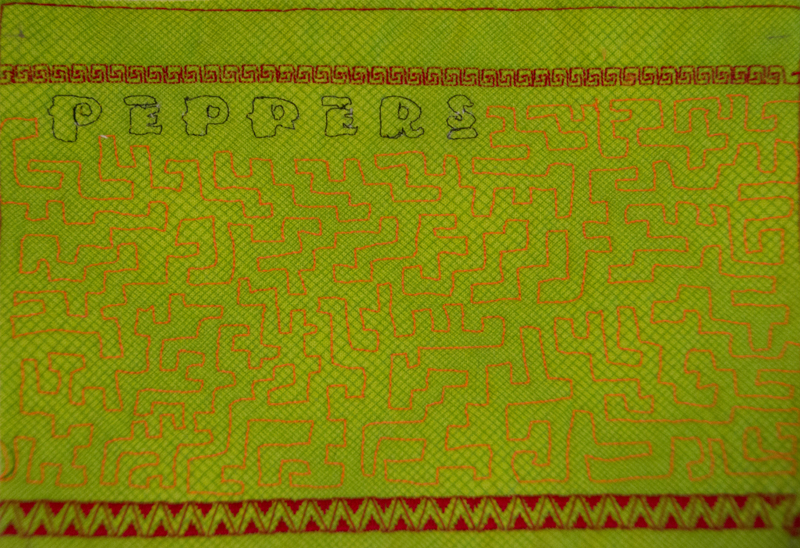
So, for my “Peppers” I used a background fabric which matches the background of my Tomatillo, but in a different color way.  I used the same pattern for the Freemotion quilting as I did on my Tomato. One of the lines of decorative stitch matches another in one of my pieces.

Why is this important? While each piece may be lovely and stand on its own, my plan is to put nine of these “Salsa” pieces together into a quilt. Although I’m doing similar techniques- Machine embroidered veges with decorative stitching and Freemotion quilting, if I’m not careful it will seem like it isn’t unified.  Other ways I’m working to unify the peace and provide repetition include using the same font for the name of each of the vegetables or fruits, using an analagous color scheme (red, orange, yellow, green), and having my quilting and decorative stitching be more sharp angles rather than curves (I think of this being more like Mayan or Aztec patterning.

On to my Avocados….!

You Might Also Be Interested in:

New 5 x 7 
Challenge Pieces
5 x 7 Week 3- 
The Start of Salsa
Developing the 
Creative Habit

Check out these other Great Blogs!
For great ideas on freemotion quilting, check out Leah Day’s FreeMotion Quilting Project

To find some wonderful quilting projects, visit Freshly Pieced

Confessions of a Fabric Addict 

Art Quilts by Nina Marie Sayre

Stitch by Stitch by Marelize Ries

Isolation.  It can be really nice to have time to yourself… time to do your projects, eat on your own schedule, stay up as late as you want.  But this weekend was more than time to myself.  Sometime on Friday, a critical piece of equipment broke down cutting off all Internet, email, WiFi and our home and business phones.  Although I still have my cell phone and texting, it’s amazing to find out how connected we are through these other forms of communication.  With my husband and sons away for the weekend, it was more like solitary confinement than a peaceful weekend to myself! Luckily, our computer expert was able to find the piece of equipment and get it installed this afternoon, so we’re back live!

Start of Red pepper- showing underlaying stitches
The good news is that I had little distraction, so I’ve made a lot of progress on my Salsa series.  First, I started with peppers:
This red pepper proved to be particularly challenging, since the perspective.  I started with making the stem, and then doing the darker parts as underlayment.  I made circular shapes, to try to get the sense of the knobby bumps on the top of the pepper.
I think it came out pretty well and like the effect of adding a little violet for the shadows.  
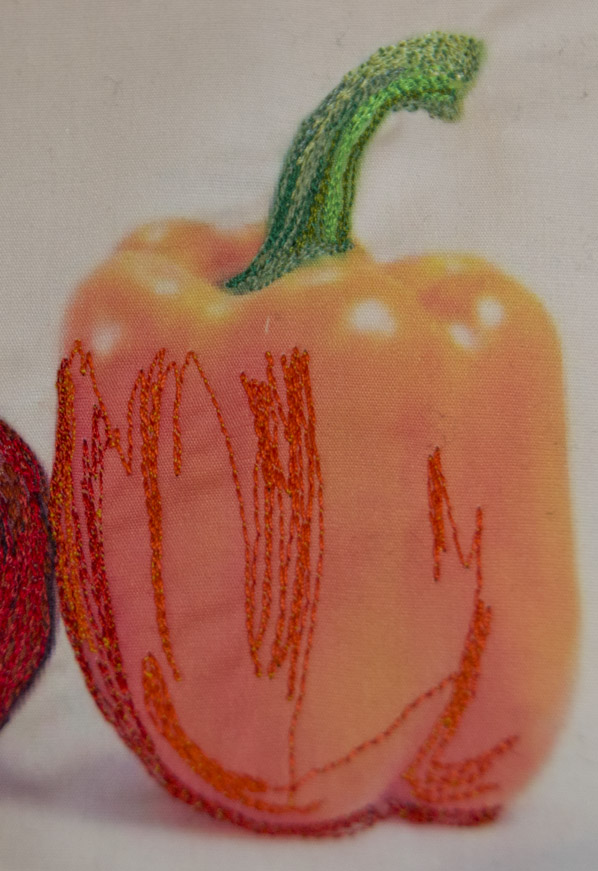
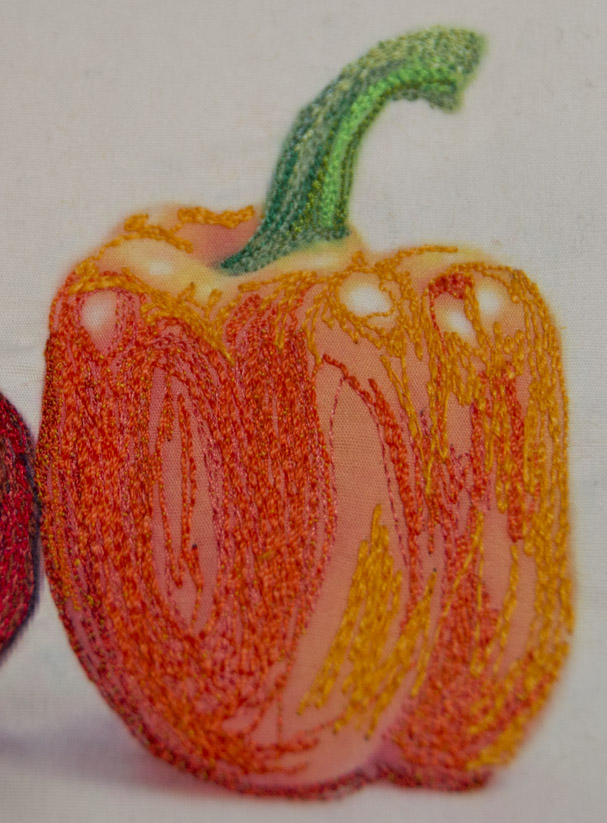
With the orange pepper, I again started with the stem and the darker shading.  As you can see, most of the stitching goes in the direction of the shape of the vegetable.  With the underlayment, I will go across the grain, but most of this stitching will be beneath other layers of color, so it won’t show the cross-grain stitches.  
I then start building layers of color up.  I generally go from dark to light, as the dark is in the shadows, so further away from the viewer and light is closer.
Here are the three finished peppers.  I need to start working on doing the freemotion quilting and decorative stitching on the background today.
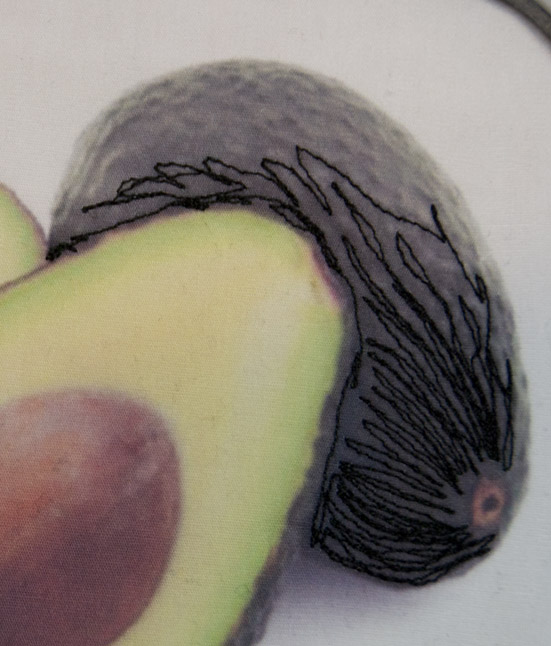
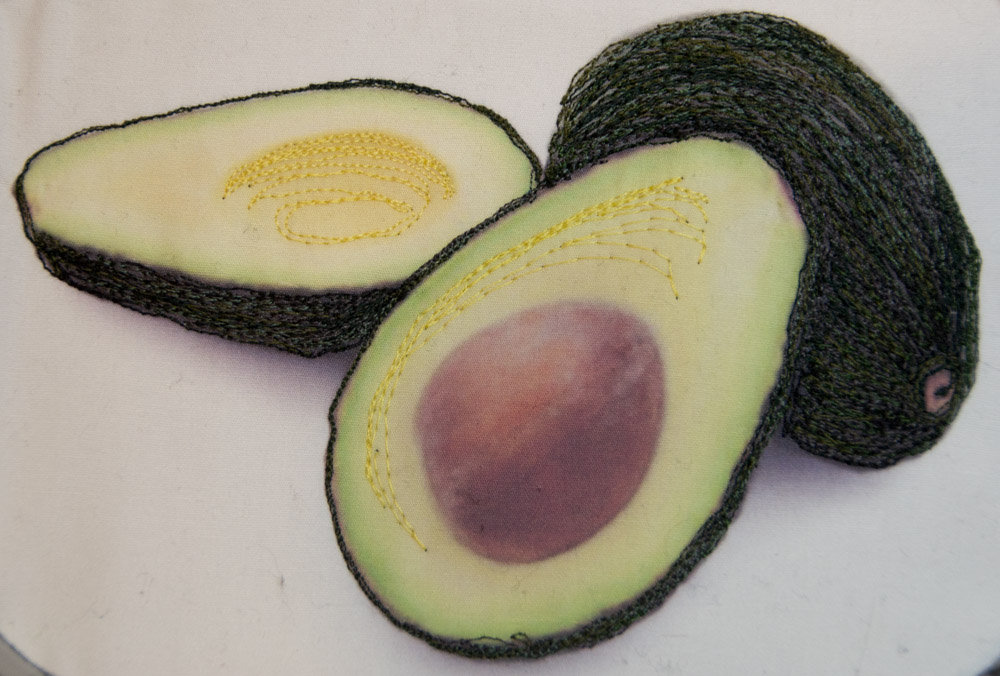
Next, I started on avocados.  Same, process, although it is challenging to think through how to be able to show the indentation of the place where the avocado seed was versus the other half with the seed jutting out. The rough texture of the outer skin was a little worrisome as well. 
I started with going over the darkest part in a thick black cotton thread.  I then added layers of dark grays and some dark muted green (basically a green that has dark gray added to it.)
I added the darkest yellow to the texture of the fruit, making it heaviest in the area that the pit was removed.  Then I layered about 10 different shades of light yellow and light green to make the fruit.
The final part of the process was to do the avocado pit or seed and the little area where the stem comes out.  
Because of how I layered the thread, both the pit areas are slightly stretched out, which will give a nice 3-D effect when I add trapunto.
I’ll be looking over Leah Day’s FreeMotion Quilting Project to find some interesting designs for the backgrounds of these two 5 x 7 Challenge pieces!


You May Also Be Interested In:

Cilantro- Si! 5 x 7 Week 3- 
The Start of Salsa
La Cebolla (Onion)

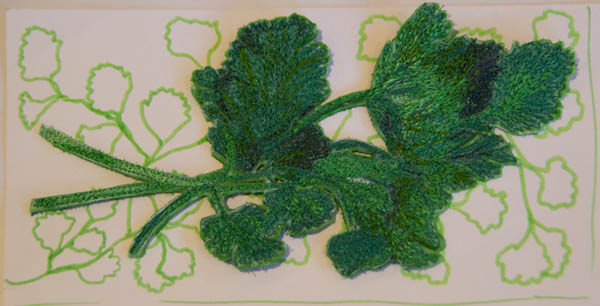
I made it back home from San Francisco late last night and finished up my 5 x7 “Cilantro” piece today.  
“Cilantro” by Christina Fairley Erickson
Freehand machine embroidery, decorative stitching and freemotion quilted
Since I already had the machine embroidered cilantro done, all I had to finish up was the background.  For this, I started with stitching the name “Cilantro” as I had with my other Salsa pieces.  To do this, I printed the word on a piece of paper-piecing paper in a funky font and then just stitched the letters out and tore away to paper.  Then I chose a few different decorative stitches to start with.
Cilantro freemotion quilting design

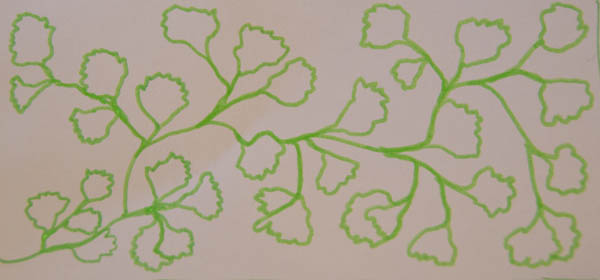
Next, I wanted to fill the middle space with freemotion quilting.  I drew out this design which I based on cilantro leaves.  I like how it looks and was ready to try it out.

However, I then lay my machine embroidered Cilantro on top of the drawn design.  I don’t think it was complementary at all!  I’d like to try the leaf pattern somewhere, but this wasn’t the right place.

Cilantro freemotion quilting design with cilantro machine
embroidery on top

Background getting filled in with cubing

So, I decided to check my favorite resource, Leah Day’s FreeMotion Quilting Project, and thought that I could slightly modify her “Cubing” design.  I worked the design at an angle or on-point, as well as putting in a lot of rectangular shapes, rather than mostly all squares.

After that, I only had to applique down my machine embroidery.  Due to the thin stalks and ruffled edges of the cilantro, I decided to cut the embroidery along the edge, color in the edges and machine applique it (rather than hand-applique as I did on the others.)  I did put a minimal amount of trapunto batting under a few leaves and left some of the edges loose, so it has a more 3-D effect.

You May Also Be Interested In:

Recognizing Our Limits 
and Not Giving Up
A Sprig Away La Cebolla (Onion)

Also Check Out These Great Blogs!

Confessions of a Fabric Addict

Nina Marie Sayre- Art Quilts

FreeMotion by the River

QuiltStory

Freshly Pieced

The Needle and Thread Network

Dharma’s Retail Store in San Rafael, CA

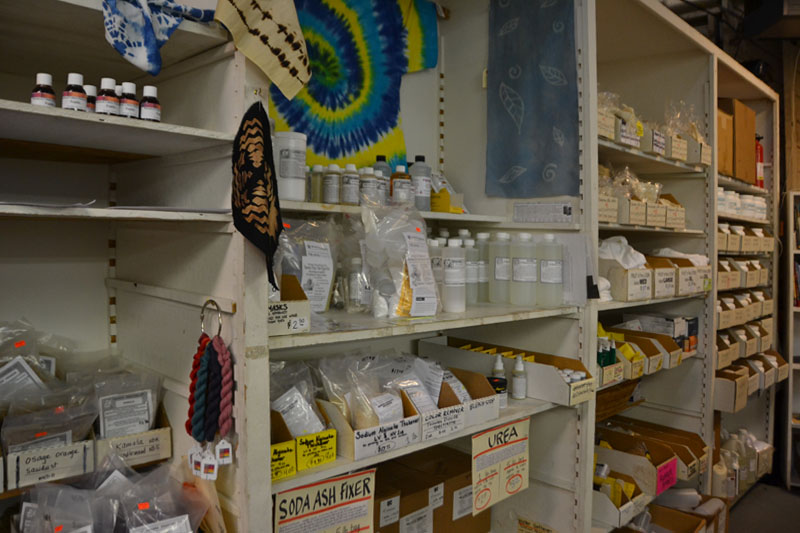
I’ve purchased many supplies at Dharma Trading Co. over the last few years.  So, when I found out that Dharma has a retail store in San Rafael (about 45 minutes outside of San Francisco, where I’m visiting), I decided to make a trip.  If you haven’t visited their website, they have almost anything and everything that you could need to dye, paint or do surface design on fabrics.

Fabric Paints

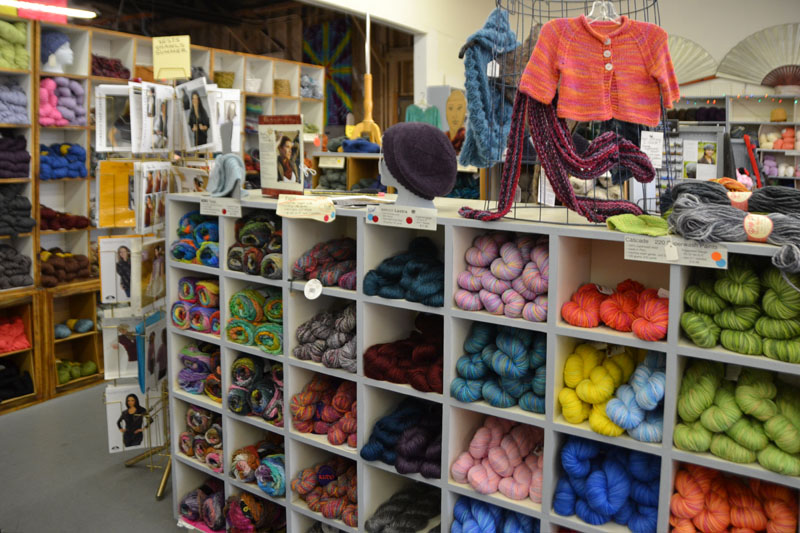
The one thing that you will find at Dharma’s retail store that they don’t have on their website is a wonderful wide supply of incredible yarns.  While I’ve so far been able to restrain myself from catching the knitting and crocheting bug, I do still love beautiful yarn.  I like couching yarns for different effects.

Dye Supplies

You can also purchase both silk and cotton garments (generally in white, but also in black and a few in other colors) to use for dyeing and painting.  The prices are very reasonable, which makes them great for resale after you surface design on them.

Shiva Oil Paintsticks, Rubbing Plates, and Metallic Pigments

Fabric Dyes and Paints

Dye-na-flow and Dyes

Custom Yarns

Custom Yarns

Custom Yarns

Custom Yarns
Silk and Cotton garments that you can dye and paint
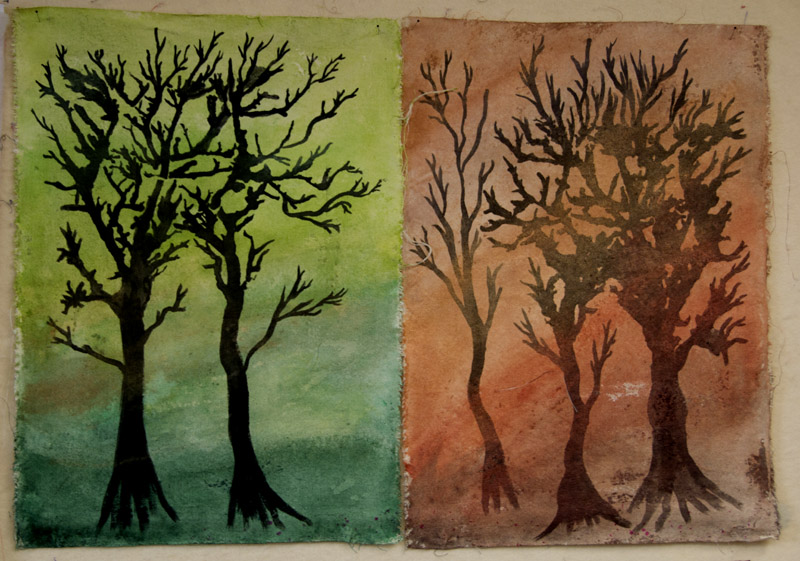
Trees- 2 of my UFO’s that could use
more paint and completion

Now that I’ve seen all their wonderful products, I can’t wait to get back home to break out my dyes, paints and other supplies and finish up a few of my UFO’s, such as these trees.  I have a few projects that I think that can be salvaged with a little overdyeing or adding some paint.
 Hope you enjoy!


You Might Also Be Interested In:

Berkeley and San Francisco 
Fabric Excursion
Recognizing Your Limits 
and Not Giving Up
Developing the 
Creative Habit

Check out Leah Day’s FreeMotion Quilting Project!

There are times for each of us when we need to just need to assess what’s realistic.  It’s been that kind of week.  As I mentioned a few days ago, I have a Valentines special trip to visit my girlfriend and her husband for their twenty-fifth anniversary.  It turns out that Valentine’s and President’s day coincide with my sons’ mid-winter break, so my family and mother and I are taking a long weekend trip down to the San Francisco Bay area.  But, as most of us know, things start to get complex as soon as you plan to get out of town.

My cilantro machine embroidery on the background fabric
I’ve chosen (still to be completed.)

Therefore, I haven’t finished my 5 x 7 art piece for the last week.  I’m not sure whether I’ll get one done in the coming week, since I’m out of town.  However, I did bring my sketchbook along, so perhaps I can finish something that way.  My current 5 x 7, my cilantro piece, is well on it’s way.  So, I might get it finished when I get back next Tuesday.

Regardless, I want to be honest with you… I think it’s important to recognize that we can’t always reach our goals.  I’ve had a few people feel like they couldn’t continue with the 5 x 7 challenge, because things came up and they weren’t able to do their artwork a week or two.  Sometimes the most important thing is to accept our failures and then get back to work.  Perseverance pays.  So even though I know last week and this coming one might not be as productive as I had hoped, I will not give up.

Here are a few more wonderful pieces from the Bellevue Art Museum “High Fiber Diet” exhibit:

“The Contact: Climax Forest”
by Ann Johnston

These three pieces by Ann Johnston were hung together and all feature Ann’s hand-dyed fabrics.  Climax Forest is hand dyed cotton that has been hand & machine stitched.  I love the complementary color scheme with the golden yellow-orange and blue.

“The Contact: Nevadan Orogeny”
by Ann Johnston

Her piece Nevadan Orogeny is also hand dyed cotton with machine stitching.  It represents the era where massive plumes of molten magma intruded into the earth’s crust, lifting and creating the western part of the North American continent.

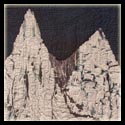
The final piece,Vigil is also hand dyed cotton with hand & machine stitching.  I love the cracked look of the mountain peaks.  I’ve climbed glaciers in Alaska and while the beauty of the great blue ice is incredible, something that many people don’t know is that the ices has cracks and lines of dirt, from the rocks that have been crushed through the force and power of the glacier.

“The Contact: Vigil”
by Ann Johnston

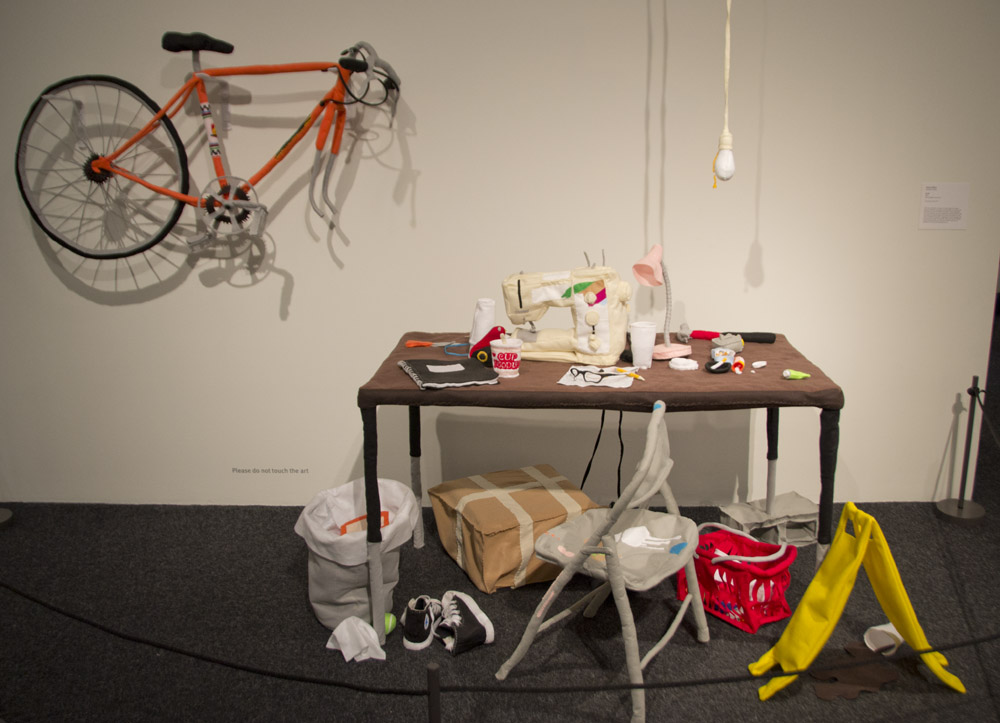
The next piece, “Studio” was constructed with Felt, Polyfiber, wire, and PVC.  Tamara Wilson of Fairbanks AK recreates her surroundings with felt and thread.  She feel that comfort and warmth, safety and security are conveyed both through the topic of her familiar surroundings as well as the usage of felt.

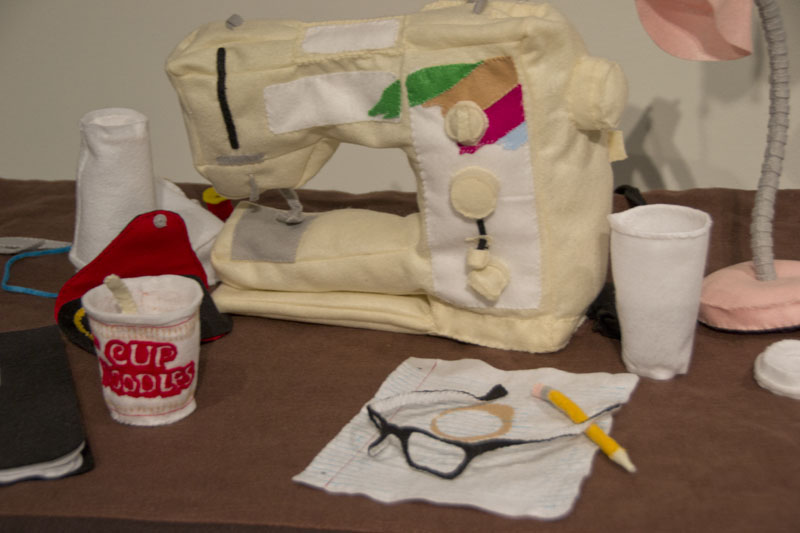
Each part of the scene below is made out of the felt and supporting pieces… and I mean every part of the scene… the bike on the wall, the light bulb and wire it hangs from, the table & chair, the sewing machine, reading glasses, cup of noodles, trashcan, etc.  All of it!

“Studio” by Tamara Wilson
“Studio” detail view

I hope this gives you a little inspiration and helps you remember that it’s ok when you don’t always meet your goals.  Goals are there to help you… to light your way.  When you have other things in your life, it’s o.k.  Learning balance is such a critical part of all of our lives.

You Might Also Be Interested In:

BAM High Fiber Diet A Sprig Away Developing the 
Creative Habit

For great ideas on freemotion quilting, check out Leah Day’s FreeMotion Quilting Project

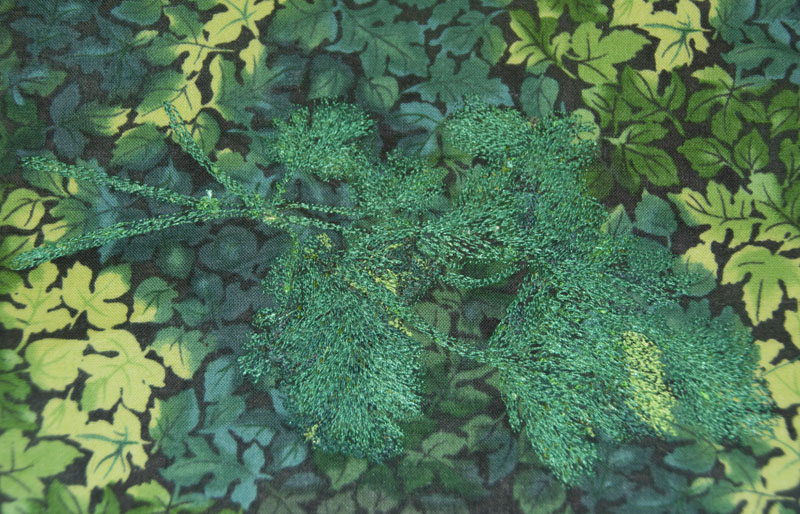
Today’s project has been working on a sprig of Cilantro for my Salsa quilt.  This has been a little more challenging, as the uneven ruffled edges of the cilantro and the thin, fine stalks are going to make it pretty impossible to turn under the edges to applique.  Unless you know a technique that I don’t!

“Cilantro” freehand machine embroidery by Christina Fairley Erickson
“Cilantro” back

So, I did this one a little differently, in that I decided to put a green, leafy background on the back, below the layers of stabilizer.  This way, I can carefully cut around my machine embroidery and fasten it to the background, but allow some of the leaves to not be completely secured, and the backing fabric will show.  I expect I’ll have to color along the edges where I cut, however.

I’m not quite sure what I’m going to do with the background this time around, though I’m considering putting it on either a red or yellow-orange piece.  While I’m working on this little sprig, here’s something to think about on a much grander scale!

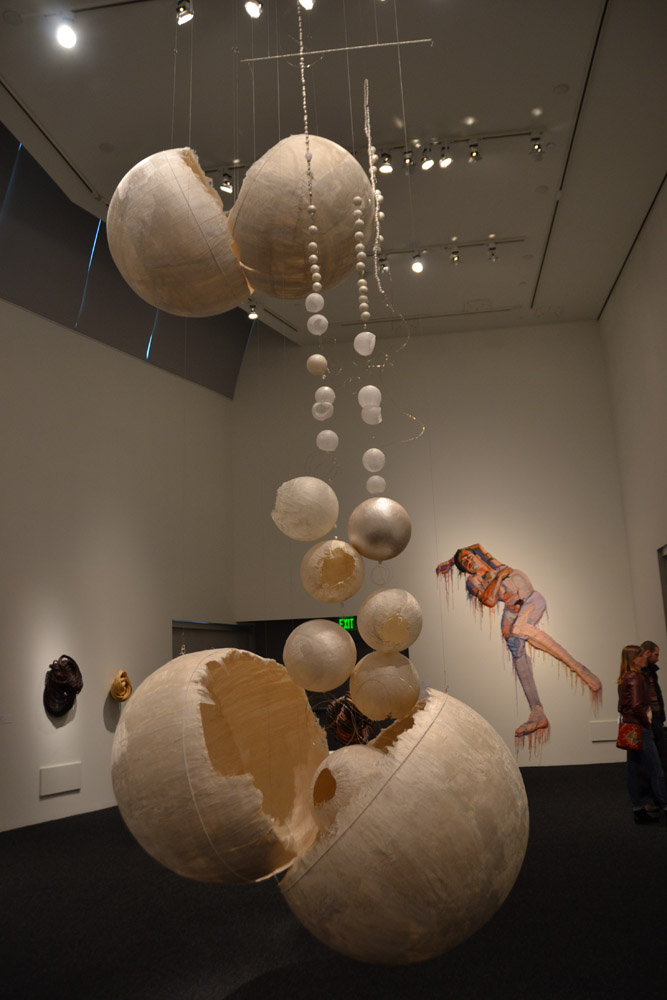
Sea Nettle” by Dina Barzel in foreground
“Bridging Shine” by Jo Hamilton in background

Yesterday, I started talking about the Bellevue Art Museum’s (BAM) current exhibit “High Fiber Diet.”  One of the artists and a friend of mine, Dina Barzel, is an incredible woman in the fiber arts.  Dina has been working as a full-time artist since 1970 and makes fiber sculptures.  I met Dina through the Surface Design Association and am happy to have her join our monthly meetings here in Bellevue.  Dina was born and grew up in the Western Carpathian Mountains of Transylvania.  The traditional uses of fibers were an essential part of everyday life, and made quite an impression on her.

Dina’s sculpture for this show, “Sea Nettle” is made of silk fibers, shaped around molds.  Some of the molds are large and light enough to even hold the artist!  The silken globe rise up to the twenty foot ceiling, some partially open, as though they are allowing others to escape from within.

In the background, you’ll see an oversized male portrait called “Bridging Shine” by Jo Hamilton. This piece is made completely of mixed crocheted yarn and is about twice the size of life.

“Sea Nettle” by Dina Brazel (detail)

“Sea Nettle” by Dina Brazel (detail)

You might also be interested in:

BAM High Fiber Diet La Cebolla (Onion) Developing the 
Creative Habit

For wonderful Tutorials on FreeMotion Quilting and more, go to Leah Day’s FreeMotion Quilting Project

Today was all about the High Fiber Diet… and I’m not talking about food!  Our local Bellevue Arts Museum or ‘BAM’ is currently hosting a Biennial exhibition which is featuring Fiber this year!  BAM has considered one of its roles to include recognizing “the enduring and uninterrupted role of craft in shaping the aesthetic landscape of the region” (from the High Fiber Diet exhibit pamphlet.)  Today they hosted an all day Symposium with incredible speakers and moderators which left me itching to come home and create!  Since today was our normal day for our Contemporary QuiltArt Association meeting, we choose to meet at the symposium instead… which gave BAM a sold-out crowd!

“Oyster Light” by Barbara Lee Smith
“Oyster Light” detail by Barbara Lee Smith

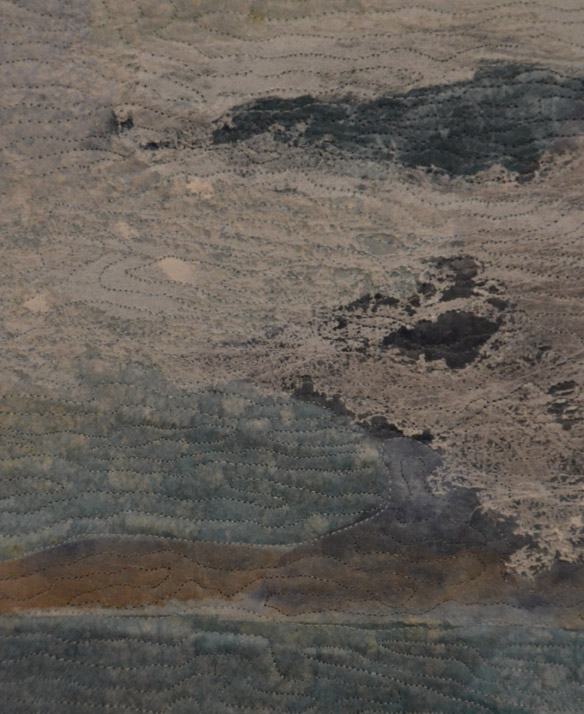
One of the well-known moderators was Barbara Lee Smith, a resident of a small island in the Puget Sound. Barbara’s piece, “Oyster Light” is made from painted, collaged, and stitched synthetic fabric- a translucent, non-woven industrial fabric that looks like Japanese paper.  Her sewing lines “echo the currents of sea and air, the topography of the earth, mapping the work with stitches that literally and figuratively finish it.”

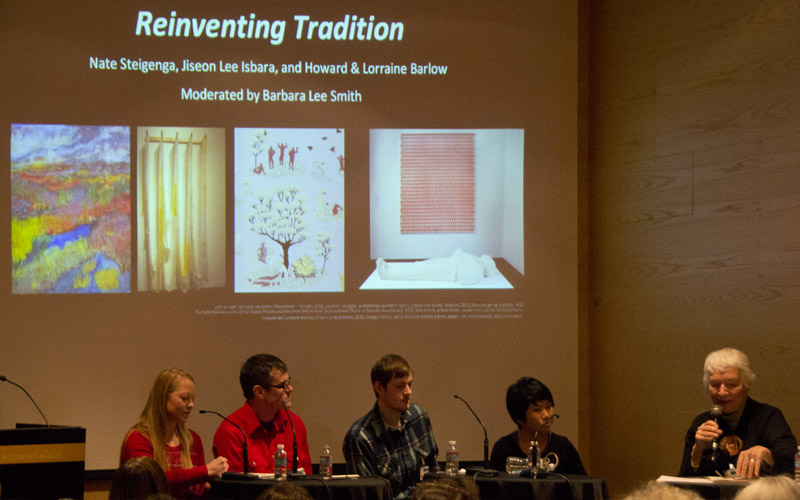
Lorraine Barlow, Howard Barlow, Nate Steigenga,
Jiseon Lee Isbara and Barbara Lee Smith
(from left to right) at BAM Symposium 2/09/2013

Barbara moderated a talk called “Reinventing Tradition” with four of the other artists in the show.  It was fascinating to hear the viewpoints and how tradition has influenced some very cutting-edge fiber artists.

“The Infallible Accounts of the Tilapia People and the Dead Which
Soon Outnumbered Them: a Toile De Jouy” by Nate Steigenga

One of the artists on the panel, Nate Steigenga, won the John and Joyce Price Award for Excellence for the BAM show, earning him his own solo show in the future.  The fascinating thing about his piece is that it is reminiscent of a traditional quilt… sort of a tree of life feel, but when you get up close it’s much closer to something you’d see Hieronymus Bosch create with fabric!  It’s actually a twist on Toile de Jouy, a type of fabric with an intricate scene printed on it.  This artwork is made from bedsheets and pillow shams are backed with ironed-on drawer liners, which gives shade and depth to semi-transparent fabrics.  Nate uses an exceptionally fine collage technique (many of his pieces are tooth-pick wide slivers.)

While I appreciate the process that went into the piece, as well as the black humor, I find it somewhat disturbing… I could stare at Barbara Lee Smith’s piece all day, but this left me somewhat disquieted.  But perhaps that is the point.

Detail from Nate Steigenga’s artwork

 There really is so much to say about all the pieces at this exhibition that it will probably take me many, many posts to share them all with you.

In a way, it was somewhat daunting. Here are “real” fiber artists… at least to this museum’s tastes.  Art should be an expression of oneself and each piece in this exhibit is so different that it’s can be overwhelming.  A few of the people discussed the sense of the the exhibit being “loud” since there is so much (44 artists… many with huge sculptural pieces) and that it isn’t a body of work that all goes together.

I found some of the work inspirational, some of it to be admired for technique, and some awe-inspiring for the scale or complexity which the artist achieved.   But, most importantly, it was wonderful to be immersed in a community of artists with a “common thread” running through us all.  Seeing all my CQA friends, meeting many of the artists with pieces in the show, it reminded me of how important it is to get out of the studio from time-to-time and see others who are involved in your genre of art.

I’ll post more photos from the exhibit soon.

You Might Also Be Interested In:

Complex Threads 1 Complex Threads 2 Viewing for Inspiration

My dear friends are celebrating their Silver Wedding anniversary on Valentines day next week.  As I was one of the bridesmaids in their wedding, I’m packing the family up and heading to visit them in San Francisco for the party.  While I did live in the city for a short time, that was half a lifetime ago… so it’s hard to decide what all we will do while we’re there.

I’m looking now for a few good options on the fiber or quilt frontier in the Bay Area to explore.  I was very sad to hear of Kasuri Dyeworks of Berkeley CA closing several years back.  I still have some of the remarkable fabrics I purchased from them.  I also just missed the Museum of Craft and Folk Art (SF) which closed at the end of 2012.

So here are some options I’ve found:

San Jose Museum of Quilts and Textiles  This sounds like a good prospect, although the upcoming exhibits don’t really sound like they are totally up my alley.

The Lacis Museum of Lace and Textiles (Berkeley)

Art Fibers Fine Yarn (San Francisco)

Dharma Trading Company Store (San Rafael)  This may be a bit too far, but I love buying my dyeing supplies from Dharma.

Anyone have experience with any of these places (positive or negative) or have a place in the San Francisco Bay Area that they’d highly recommend?  I’d love some guidance and promise to share whatever I find!